
Get more details about this project
What you need
1 square of red cloth such as cotton, linen or wool – keep it natural. The material should be approximately as long as your longest feather.
Ceremonial herbs (sage,

Wax-treated leather twine
1 square of leather
Leather cording


Instructions
Important Cultural and Legal Note
Feather fans have important ceremonial uses in some Indigenous cultures, with materials, construction and use guided by specific community traditions.
This tutorial is intended for making a personal keepsake or decorative nature craft. It should not be presented as an authentic Indigenous ceremonial object or used to reproduce sacred designs without appropriate cultural knowledge and permission.
Laws governing the collection and possession of wild-bird feathers vary by country, region and species. Even naturally shed or ground-found feathers may be protected.
The safest option is to use commercially purchased craft feathers, feathers from domestic birds or feathers you have confirmed are legal to possess. Never disturb nests, wildlife or protected habitats.
Introduction
A handmade keepsake can help preserve a memory, mark a personal change or simply celebrate the colours and textures found in nature.
For this project, a selection of feathers is arranged into a small fan and secured around the shafts. A layer of natural cloth creates the handle core, while soft leather and decorative cord provide a comfortable, finished exterior.
Before starting, consider what you would like the finished piece to represent. You might select colours connected with a loved one, include a stone collected during a special trip or add a charm that marks an important event.
Instructions
Step 1: Select and inspect the feathers
Choose a collection of purchased craft feathers or other feathers you are legally permitted to possess.
Use a mixture of lengths, colours and markings, but make sure the shafts are long enough to form a secure handle.
Inspect the feathers for damage, dirt or insects. Follow the supplier’s cleaning instructions if necessary and allow the feathers to dry completely before use.
Avoid washing delicate feathers unless you know they can tolerate moisture.
Step 2: Arrange the fan
Place the feathers on your work surface with their most attractive sides facing upward.
Position the longest feathers toward the back and centre. Arrange shorter feathers along the sides and front to create a balanced fan shape.
A colourful eye feather or another distinctive feather can be used as the focal point.
Continue adjusting the placement until the feathers overlap neatly and the shafts form a manageable bundle.
Step 3: Bundle the feather shafts
Hold the arrangement firmly near the base of the feathers.
Wrap waxed twine
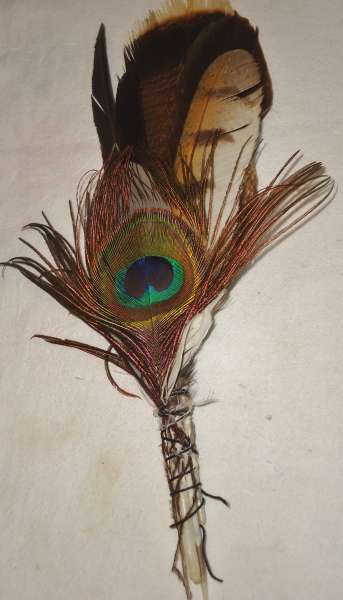
Measure and cut the leather so it’s approximately ½ wider than the circumference of the red handle. If you wish to make fringe at the bottom the leather can be any length you desire. If you don’t want fringe cut the leather long enough to cover the shafts by about ¼ inch.
Complete fringe before moving to the next step.
Place the fan handle in the center of the leather so the “seam” will be in the center front. Pull the leather snugly from both sides and secure it with leather cording – use the same criss-cross pattern you used with the waxed twine. This process requires patience: pull the leather, wrap one section and repeat, while all the time keeping the seam straight and the leather cording taut. If you have difficulty just get the leather secured on the handle then go back and make adjustments. Tie the cording at the bottom.
To make perfect fringe: It’s nearly impossible for a beginner to hand-cut fringe and make it even. Use a straight edge and a pen to mark your cuts on the wrong side of the leather then cut with a very sharp pair of scissors or utility blade.
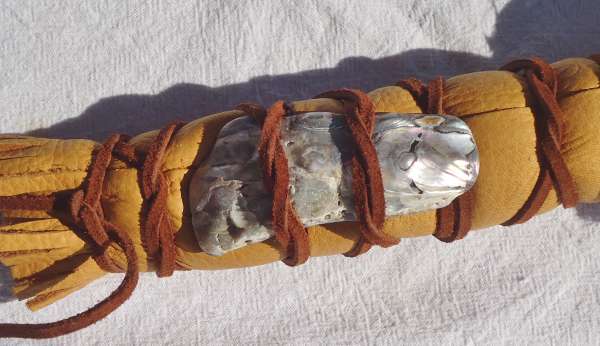
Add a crystal, stone or embellishment to the handle by tucking it under the leather cording as you wrap the handle.




The word you want to use is spelled “taut” not “taught” for keeping the cording tight. “Taut is an adjective that is most often used to refer to something that is pulled tight, like ‘a taut rope'”.
as well as any predator birds such as hawks and eagles. Actually Federal felony if found in possession of them.
Thank-you…………
Just be aware that it is also illegal to possess the feathers of migratory birds, even if they are found on the ground while walking or underneath the bird feeder. This is supposed to prevent illegal hunting/killing of the birds.
But if ur intent is just to collect the feather and not hunt or kill, then why would it still be illegal? I mean its not a kept trophy of a kill. So having them would have to have another reason for being illegal besides killing . I’m just curious because i didn’t know that
The Migratory Treaty Bird Act was written that way to prevent people find killing birds for feathers and then claiming they found it on the ground. But realistically, nobody’s coming after you for your molted feather collection…Unless it’s from an eagle and you’re not Native.
I love the leather, and feathers, and that you go and pick up the feathers outside yourself. Also that it means something, the idea of ridding yourself of negative energy is awesome. Thanks for showing us this. Louella